Funding 15 November 2026
Who wins Horizon Europe projects in Lithuania? A review of 610 projects
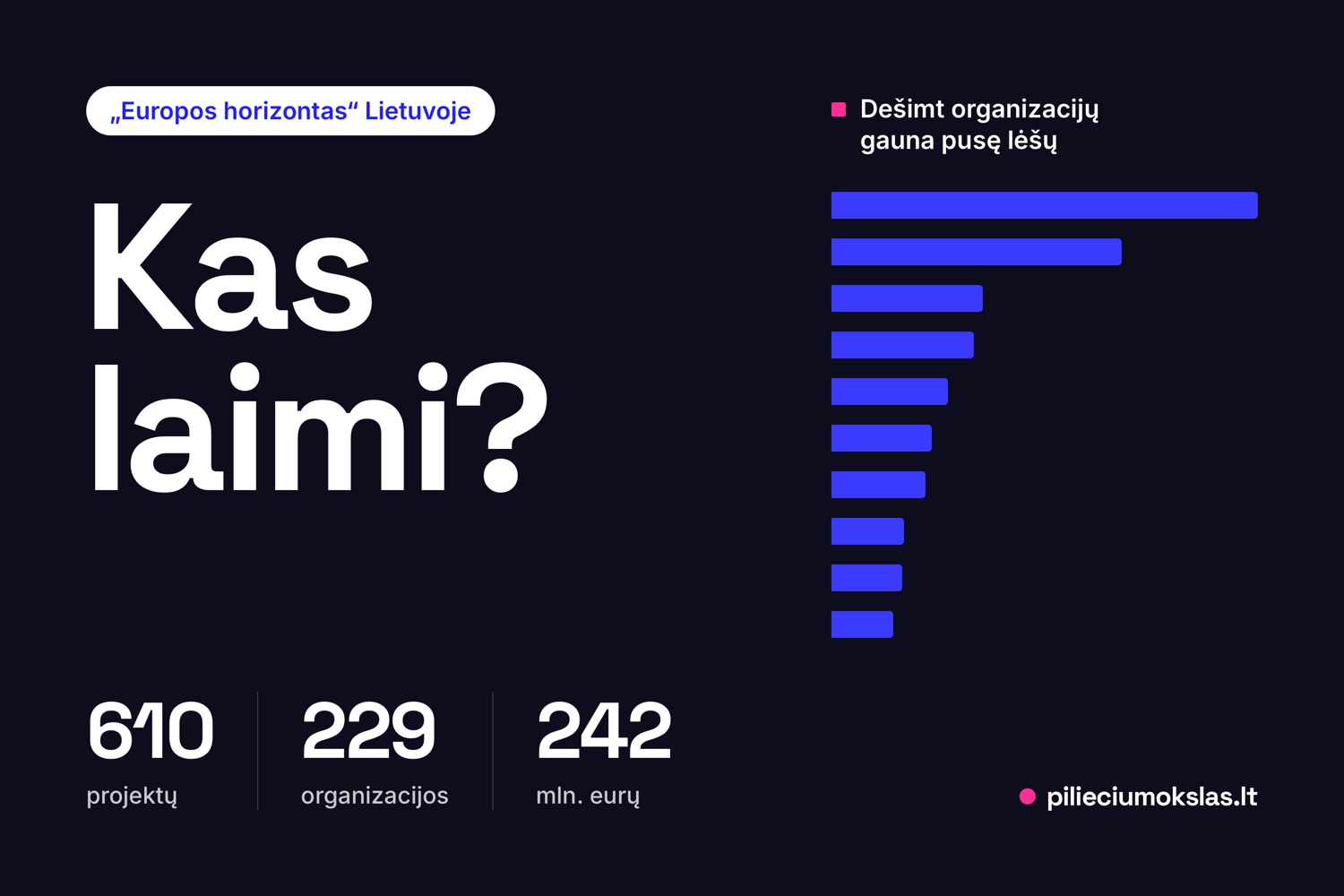
Who in Lithuania runs Horizon Europe projects, who receives most of the funding, and how many projects promise to involve people? The Lithuanian Citizen Science Association reviewed the European Commission's open CORDIS data on every project with Lithuanian participants. The figures cover grant agreements signed by 29 October 2026.
Key figures
- Lithuanian organisations take part in 610 projects. That makes 821 participations, because several Lithuanian organisations can work in one project.
- 229 organisations take part. They receive EUR 242.2 million in EU funding.
- Over the whole of Horizon 2020, Lithuanian organisations received EUR 94.2 million. Lithuania's share of programme funding has grown from 0.14% to 0.37%.
- On 14 November 2026, 441 projects were running, 127 had ended and 42 had not yet started.
- Organisations in Estonia receive EUR 354.5 million (966 participations), those in Latvia EUR 157.3 million (545 participations).
Ten organisations receive half of the funding
The ten largest recipients account for 50.2% of the total, the top five for 37.1%. Vilnius University leads (EUR 34.0 million, 100 participations), followed by Kaunas University of Technology (EUR 23.1 million, 76 participations). The Research Council of Lithuania, in third place, received EUR 10.4 million of its 12.1 million through co-funded actions (COFUND).
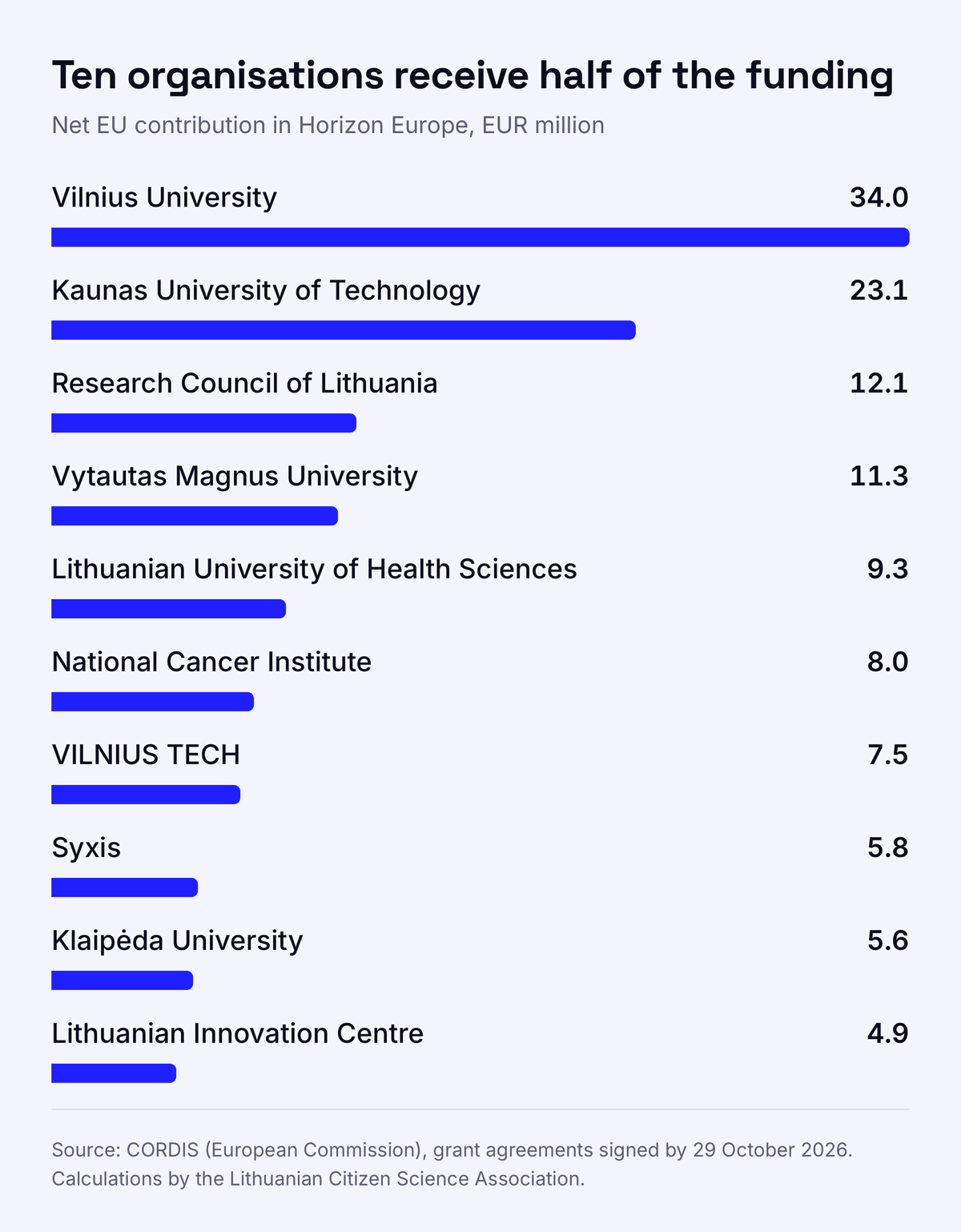
At the same time, 145 of the 229 organisations take part in only one project.
By the organisation type recorded in CORDIS, higher education and other education establishments (12 organisations) receive 38.8% of the funding, companies (103) 25.7%, research organisations (23) 17.8%, public bodies (47) 12.1%, and associations, NGOs and other organisations (44) 5.7%. In that last group, the largest amounts go to AgriFood Lithuania DIH (EUR 4.6 million, 21 participations) and the cancer patient support association POLA (EUR 1.5 million, 6 participations).
Two thirds of participants are newcomers
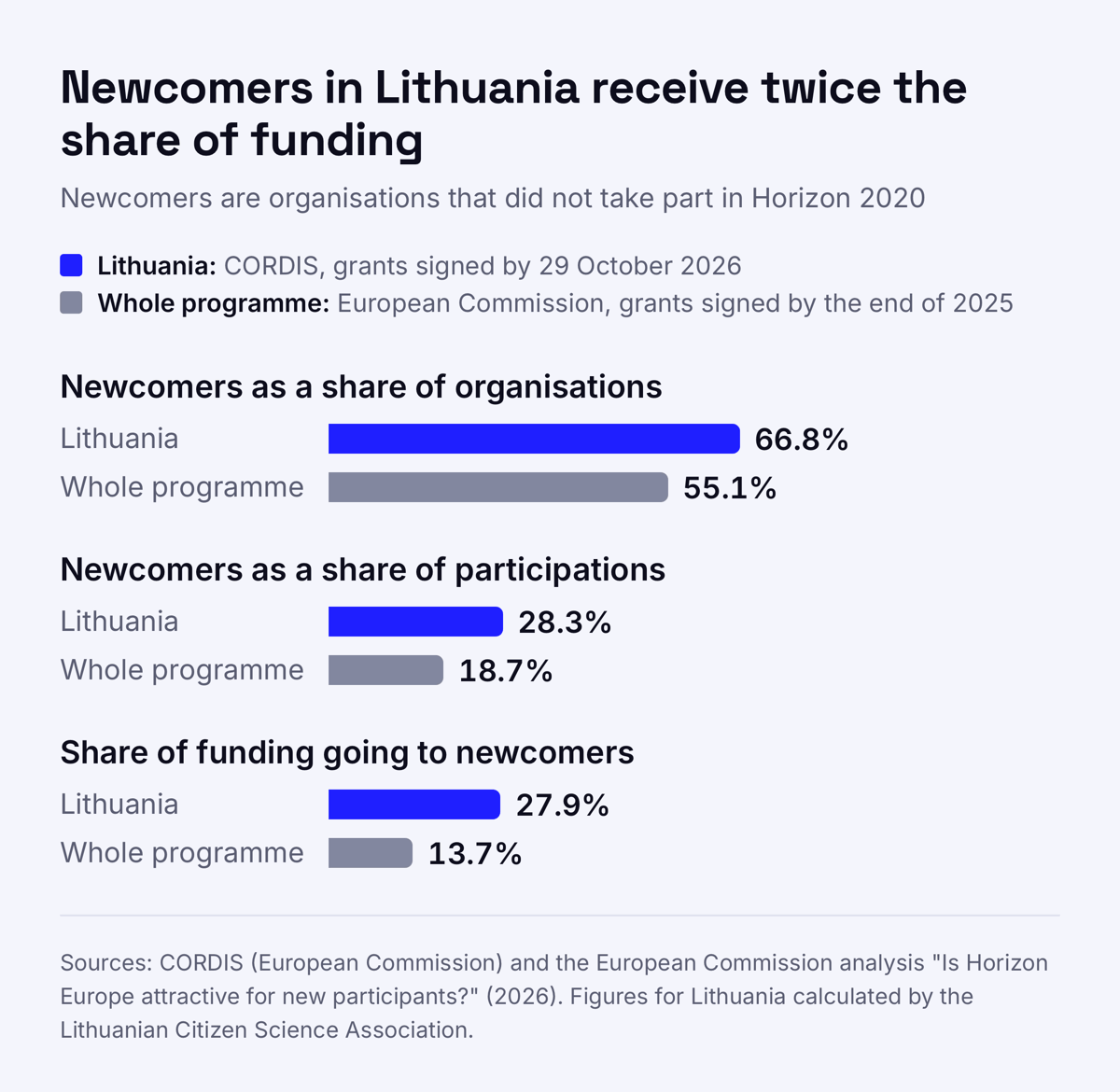
153 of the 229 organisations (66.8%) did not take part in Horizon 2020. They account for 28.3% of participations and 27.9% of the funding. Across the whole programme, according to the European Commission, newcomers make up 55.1% of organisations and receive 13.7% of the funding.
- Half of the newcomers are companies (76). Another 34 are associations, NGOs and other organisations, and 29 are public bodies.
- Three quarters of newcomers take part in one project. A newcomer has 1.5 participations on average, a returning organisation 7.8.
- Of the 191 Lithuanian organisations that took part in Horizon 2020, 76 have returned to Horizon Europe so far.
- The Lithuanian Citizen Science Association is itself among the newcomers, as an associated partner in the CLIMAS project.
We covered the European Commission's analysis of newcomers across the programme in an earlier post.
Where the funding comes from
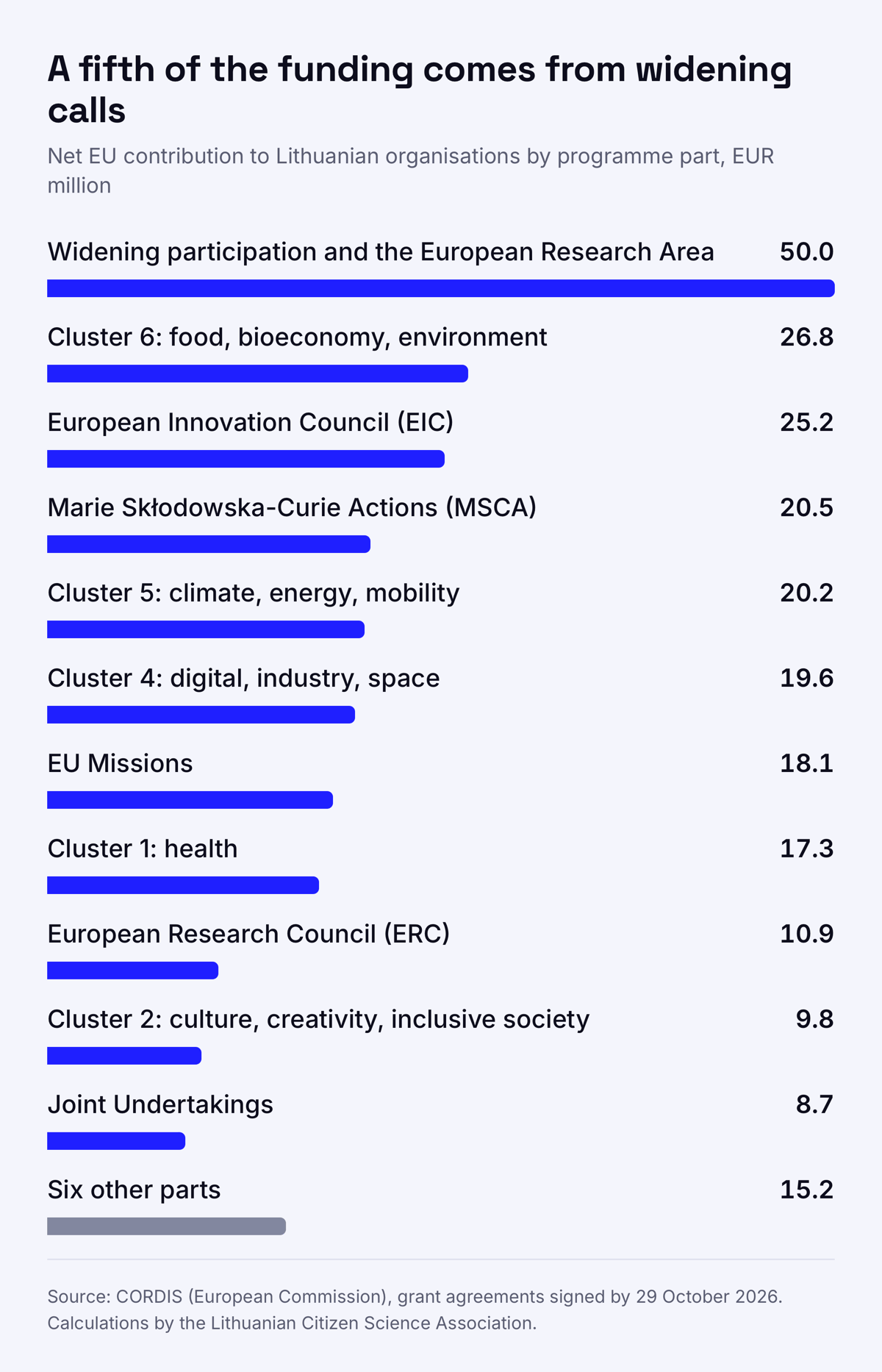
A fifth of the funding (EUR 50.0 million) comes from the programme part "Widening participation and strengthening the European Research Area". Most projects are in the Marie Skłodowska-Curie Actions (111) and in Cluster 6 (83), which covers food, bioeconomy, natural resources, agriculture and environment. In Cluster 2 (culture, creativity and inclusive society) Lithuanian organisations take part in 30 projects and receive EUR 9.8 million.
28 consortia are led from Lithuania
Lithuanian organisations coordinate 100 projects. Of these, 72 are individual grants: 52 Marie Skłodowska-Curie postdoctoral fellowships, 7 European Research Council grants, 7 European Innovation Council Accelerator projects and 6 other single-company projects. That leaves 28 consortia coordinated by a Lithuanian organisation. These counts include projects that have already ended.
- VILNIUS TECH coordinates six of them, Kaunas University of Technology five, Vilnius University four and Vytautas Magnus University three.
- 11 consortia are funded from widening calls, 6 are Marie Skłodowska-Curie Actions and 4 belong to Cluster 2.
- In the health cluster (38 projects) and the digital, industry and space cluster (59 projects), Lithuanian organisations coordinate no project.
One project in four promises to involve people
The title, summary or keywords of 162 projects (26.6%) mention co-creation, participatory approaches, living labs, citizen or community engagement, or citizen science. Among Lithuania's collaborative projects the share is 30.2%, compared with 22.2% across the programme.
- Co-creation is the most common term (81 projects). Participatory approaches appear in 41 projects, co-design in 41, living labs in 22, citizen engagement in 19, citizen science in 14, community engagement in 12, and deliberation or citizens' assemblies in 4.
- Most of these projects are in Cluster 6 (45 of 83), EU Missions (23 of 49), widening calls (26 of 59) and Cluster 2 (14 of 30).
- 91 Lithuanian organisations work in these projects. In mid-November, 116 of the projects were running.
Citizen science is mentioned directly in 14 projects: CITIES-IN-STEAM, CLIMAS, CS-FACTOR, DietWise, DIGICHer, EUROPAST, GuardIAS, NATALIE, ProBleu, RIECS-Concept, ROWER, Science4Everyone, VISIONAIR and WISE.
A word search shows what a proposal promised. The data does not show how those promises are being kept.
Funding is concentrated in Vilnius and Kaunas
Organisations in Vilnius County (153) receive 62.4% of the funding, those in Kaunas County (44) 30.8% and those in Klaipėda County (13) 4.4%. The other seven counties have 16 participating organisations in total, with 2.2% of the funding.
What ends and what starts
By the end of 2027, 192 projects with Lithuanian participants will end, and 46 of them promised to involve people. Since 1 July 2026, 98 projects have started or are about to start, 22 of them on 1 January 2027.
How we counted
- The source is CORDIS open data on Horizon Europe and Horizon 2020 projects (European Commission), files dated 5 November 2026.
- A participation is one organisation record in one project. We count coordinators (100 records), participants (647), associated partners (50) and third parties (24).
- Funding means the net EU contribution to the organisation. Associated partners receive no EU funding.
- A newcomer is an organisation whose code is not in the list of Horizon 2020 participants. An organisation that was reorganised or received a new code also counts as a newcomer.
- The programme part is taken from the call topic code, the county from the region code or city recorded in CORDIS. Three organisations could not be placed.
- Collaborative projects are all projects except individual fellowships, European Research Council grants and European Innovation Council projects.
- The participation terms were searched automatically, in English, in project titles, summaries and keywords.
- Official statistics on Lithuanian participation, based on eCorda data, are published every month by the Research Council of Lithuania (in Lithuanian). Its figures may differ slightly because the data source and the counting method differ.
Found a mistake, or is your project missing? Write to info@pilieciumokslas.lt and we will correct it.
For transparency: the association is an associated partner in the CLIMAS project, and its members work at VILNIUS TECH and Kaunas University of Technology.
Preparing a proposal?
- Our funding calls database lists open calls and is updated daily.
- At Proposal Fridays we offer free consultations to early-career researchers, communities and NGOs who want to use citizen science and other participatory methods in their projects.
Illustrations: Lithuanian Citizen Science Association, based on CORDIS data