Funding 12 November 2026
Is Horizon Europe open to newcomers? What a new European Commission analysis shows
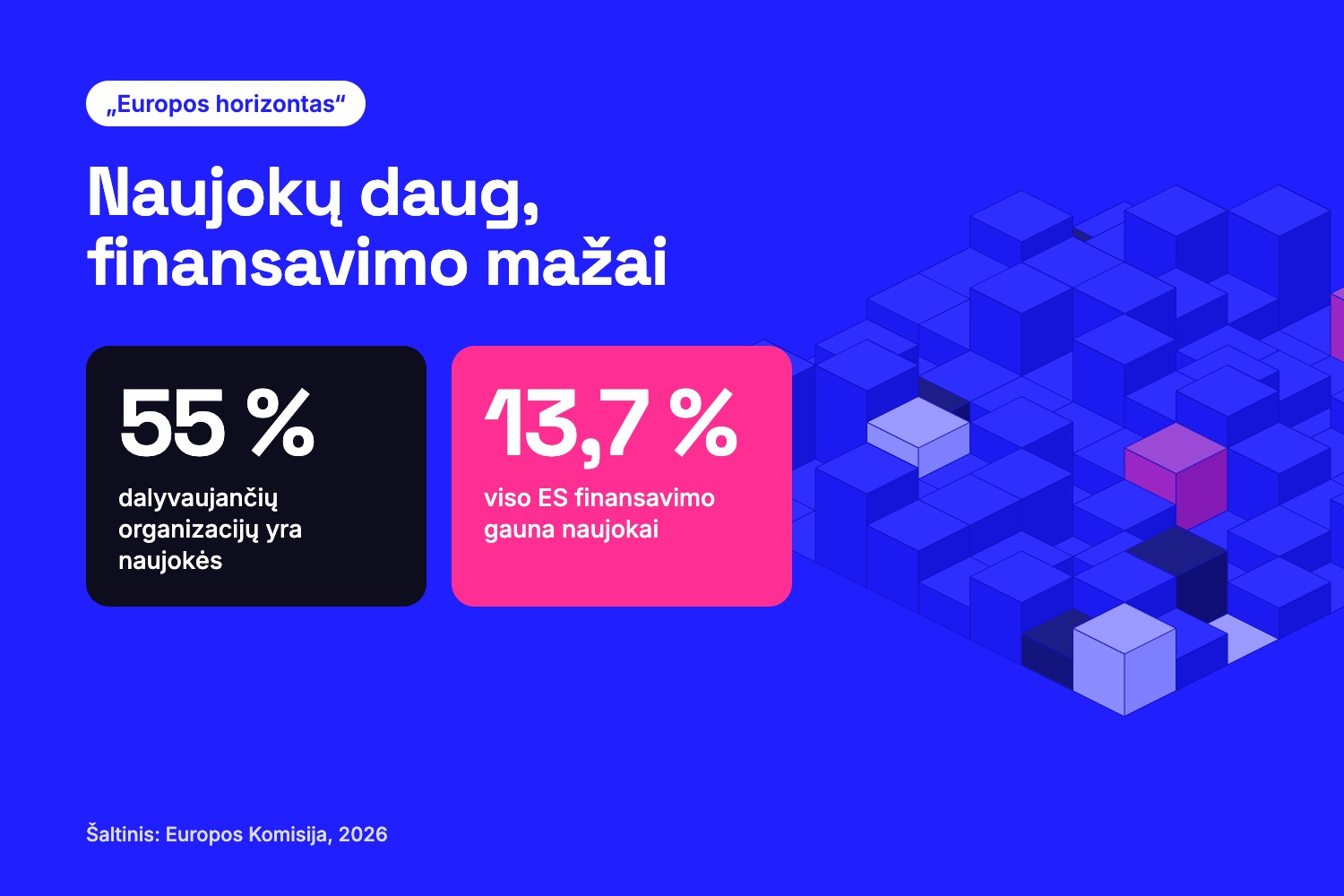
The European Commission's Directorate-General for Research and Innovation has published the analysis "Is Horizon Europe attractive for new participants?". It looks at how organisations that did not take part in Horizon 2020 are faring in Horizon Europe. The analysis covers grant agreements signed until the end of 2025.
Key figures
- 55.1% of all organisations in the programme are newcomers, but they account for only 18.7% of project participations and receive 13.7% of the funding (EUR 7.2 billion out of 52.8 billion).
- Compared with the same point in Horizon 2020, there are fewer newcomers: then they made up 67% of participants and received 17.2% of the funding.
- 82% of newcomers took part in only one project. Of the Horizon 2020 newcomers, only 23.2% are taking part in Horizon Europe.
- Experienced organisations submit 22 applications on average, newcomers only 2. Experienced applicants also have a somewhat higher success rate: 18.9% compared with 15.6%.
What this means for Lithuania
Lithuania is among the countries where newcomers receive more than a fifth of the EU funding the country has won. The analysis shows that new organisations find it easiest to enter through collaborative projects in Pillar II (Global Challenges and European Industrial Competitiveness). Partnerships that rely on established networks are harder for newcomers to join.
What helps
The authors conclude that newcomers would benefit most from more guidance in preparing and submitting applications, and that applying more than once helps organisations establish themselves in the programme. In other words, a first rejection is no reason to stop.
The Lithuanian Citizen Science Association tries to help with both:
- Our funding calls database lists open calls and is updated daily.
- At Proposal Fridays we offer free consultations to early-career researchers, communities and NGOs who want to use citizen science and other participatory methods in their projects.
More information
- Analysis "Is Horizon Europe attractive for new participants? Breaking down participation trends across programme parts and countries" (European Commission, 2026)
Illustration: Lithuanian Citizen Science Association, based on European Commission data