News 26 December 2025
Circular construction starts with people: how to involve citizens in the "second life" of building materials
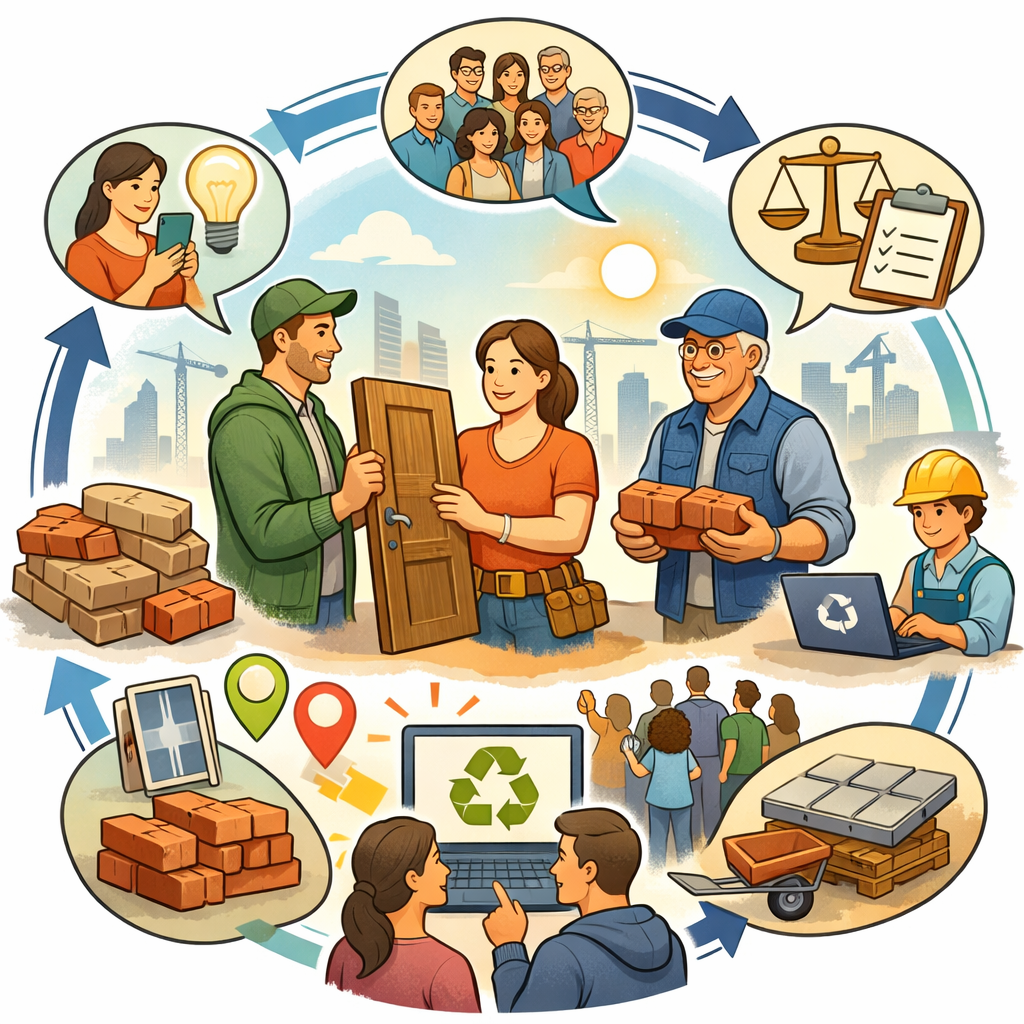
Imagine an ordinary situation: you are renovating a flat or a house. You carry out old doors, tiles, boards, a radiator, perhaps even windows. Some of them are still quite "alive", just no longer fashionable or not suitable for your project. Yet most often they end up in the waste stream.
Why does this matter? Because scientific research shows that the construction sector is one of the largest consumers of global energy. According to the United Nations Environment Programme, the construction and operation of buildings account for more than a third of global energy consumption. Other studies reveal one more paradox: although more than 90% of the "content" of buildings could in theory be reused, in reality only about 20-30% of building materials get a "second life" after demolition. These figures lead to an important conclusion: the problem is not purely technological. Studies stress that the reuse of building materials stalls not because solutions are lacking, but because people, information and trust are not sufficiently connected. It is precisely for this reason that citizen involvement becomes the decisive factor.
When the circular economy in construction is discussed, much attention is often given to companies: contractors and the demolition or recycling sector. However, an analysis of the experience of different countries and of digital platforms for exchanging building materials shows that end users, namely individual homeowners and do-it-yourself enthusiasts, hold an important place in them. This shows that construction based on circular principles cannot take place only "among professionals".
Research allows the role of citizens to be seen much more broadly. Residents are owners of materials who decide after a renovation whether to throw the materials away or pass them on to someone else. They are buyers who can consciously choose reused materials. They are also opinion formers whose experiences foster trust or distrust in such solutions within communities. Finally, citizens also become a source of pressure when their needs begin to influence municipal decisions, rules and incentives.
The scientific literature increasingly stresses that digital platforms can speed up this process. They help not only to connect supply and demand, but also to create transparency, traceability and trust, qualities that are especially important when it comes to used building materials. Nevertheless, research also clearly shows that technologies alone do not ensure a circular economy.
The success of platforms depends on whether they are able to involve people. An analysis of different examples shows that citizen involvement grows stronger when trust is built, clear and practical information is provided, and participation itself is simple and meaningful. People often do not choose reuse not out of unwillingness but because of uncertainty: how to dismantle, whether the material is suitable, whether it will be useful to anyone.
When these barriers are lowered, individual decisions begin to add up. Research shows that over time this turns into community practices: people share experience, make recommendations to one another and join local initiatives. In this way circular construction begins to work not as an isolated experiment but as a social process.
The circular economy in construction is therefore not only a matter of technology or regulation. Scientific research shows ever more clearly that its success depends on people: on citizens' everyday decisions, trust and willingness to take part. When it is simple, safe and meaningful for a citizen to do so, construction waste begins to turn into what it can truly be: resources with a second life.
The research results were obtained in the course of the project "Civil Engineering Research Centre" (Project No. S-A-UEI-23-5, ŠMSM)