News 1 November 2026
KTU event slides: what residents think about science and what researchers need
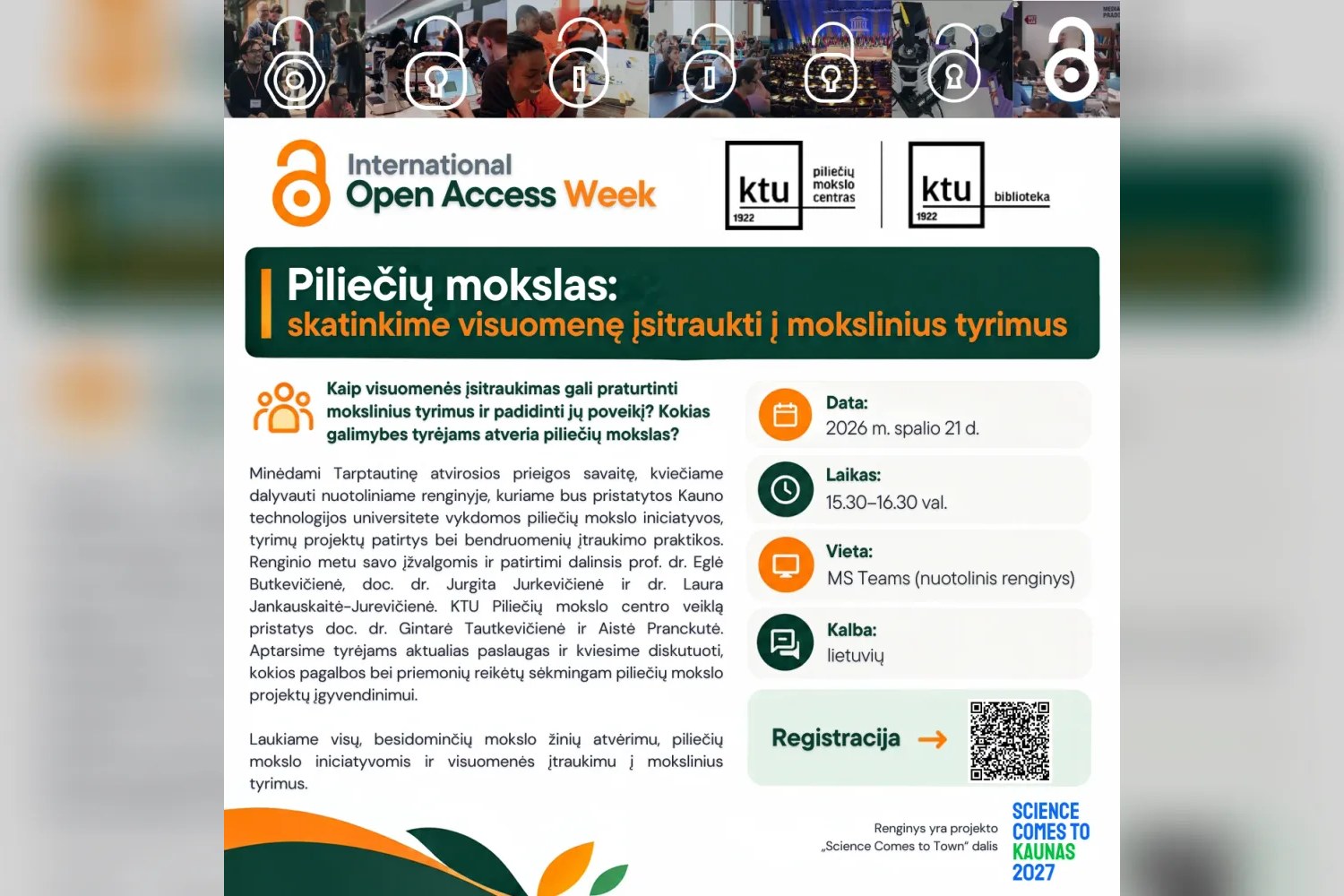
More than 50 researchers, lecturers, doctoral candidates, students and library professionals joined the online event on citizen science that Kaunas University of Technology held on 21 October for International Open Access Week. The slides are now public, and the figures in them are worth a look.
What residents of Lithuania think
Assoc. Prof. Dr. Jurgita Jurkevičienė opened the event with how experts at higher education institutions assess society's preparedness for threats and how citizen science builds civic competences. Prof. Dr. Eglė Butkevičienė, a founding member of the Lithuanian Citizen Science Association, presented results of a representative survey from the RECONECT project:
- 64% agree that science can help solve society's problems, and 60% that researchers publish reliable results.
- 42% think researchers are too closed off from society.
- Only 21% consider government investment in science sufficient.
The slides show participation falling as the effort rises. 59% followed science news, 37% had been survey respondents, 14% had helped researchers collect data and 10% had taken part in citizen science projects. Another 43%, however, might join such projects, and 39% might help collect data.
The project's conclusions include a practical message for anyone planning a project: most residents would join data collection if the process were clear and simple and let them see a real effect on decisions.
Recommendations
RECONECT developed recommendations for municipalities, research institutions, communities and NGOs. The slides show four of them:
- Use citizen science to prepare and monitor plans for resilience, crisis management, social welfare, health, the environment and safety.
- Provide targeted funding for local community resilience and citizen involvement initiatives.
- For research institutions: do research with communities, not only about them.
- For communities and NGOs: start projects and collect local knowledge and data on the environment, services, safety and social needs.
What researchers need
Assoc. Prof. Dr. Gintarė Tautkevičienė and Aistė Pranckutė presented the work of the KTU Citizen Science Centre and the results of the 2024-2025 project on developing citizen science at KTU. The university's interest map draws on a survey of 110 researchers, lecturers and administrators and a focus group. The motivating factors mentioned most include funding, mutual benefit, training and methodological support, although "I have no opinion" was also among the most common answers.
88 researchers took part in the training "Citizen science ecosystem", and KTU approved guidelines for starting and running citizen science projects. The Centre's strategy and action plan for 2026-2028 rests on four directions: integration across the university, public involvement, stronger competences, and sustainability and long-term impact.
Co-creation in the city
Lecturer Laura Jankauskaitė-Jurevičienė of the KTU Faculty of Civil Engineering and Architecture showed two ways of involving people in urban research.
Genius Loci: urbanisation and civic community (2020-2023). The project began with a new street that Kaunas municipality announced for the Šančiai district in 2019. School pupils, residents, people with disabilities and architecture students drew mental maps in workshops and marked places that matter to them on interactive maps of memory, present and nature. These data fed into urban visions, the community chose the winner, and the results were presented to the municipality and the Seimas.
GreenInCities (2024-2027). In Birštonas, school pupils, seniors, students and experts are looking for nature-based solutions for the Nemunas riverside. Unusually, other forms of life count as participants too: the chosen species is the merganser, and the spaces are designed with it in mind. The workshops record biodiversity and use empathy maps and AI, and the results go into a digital twin of Birštonas.
Slides (in Lithuanian)
- Strengthening societal and community resilience through citizen science, Prof. Dr. E. Butkevičienė
- Involving the public in research: the faculty's experience, Lecturer L. Jankauskaitė-Jurevičienė
- The Citizen Science Centre, Assoc. Prof. Dr. G. Tautkevičienė, A. Pranckutė
More on the survey: Prof. Butkevičienė's comments on LRT.lt.
Report on the event on the KTU Library website
Image: KTU Citizen Science Centre